Last post, probably for a while. I want to finish up by talking about one of the questions I have to ask myself every now and again: Does any of it matter?
After I became a vegetarian, I told one of my good friends about why I had decided to do it. And she said, "Well, I'm glad you think that does something."
She has a point, right? I think this is what stops many of my ethically minded friends from making radical life changes for idealistic moral reasons. Does it really make any difference for one person to stop buying meat? Can our refusal to eat most chocolate really end slavery in another country?
To be honest, I don't know. The machine, so to speak, is overwhelmingly large.
But what I do know is that it definitely doesn't help anything for you to do nothing. I feel that being a vegetarian has allowed me to introduce lots of people to issues within the food industry, or the concept of animal rights. I don't know that I've ever changed anyone's mind. But I think I have gotten some people to broaden their thinking. And, in my opinion, when lots of people start broadening their minds, that is when real change can happen.
Thursday, December 6, 2012

Food, Inc.
Oh hello. I didn't see you there. Have you missed me for the 30 seconds between these posts?
While I finish up my blog, I'd like to talk about some other major influences on my food philosophy.

By now, you've probably seen it. It's free on Netflix, it's one of the most successful current food documentaries. If you haven't, go watch it. I first saw it over Christmas Break 2009. After watching it, it just seemed incredibly clear to me that I needed to be a vegetarian. I had already known this, really, after reading Animal, Vegetable, Miracle a few months earlier. But watching Food, Inc., I just felt that I had no excuse. I knew the facts, I knew where my food was coming from, and morally it didn't seem to make any sense to me to continue buying a product when I knew I did not like the way it was being produced. So I quit. And it's been great, I absolutely love being a vegetarian.
Animal, Vegetable, Miracle
Well, it's the last day of the semester, and time for me to squish in some last minute posts for grade purposes. That's lame, but at least I'm being up front about it.
It seems like a decent number of people have found the chocolate posts helpful and interesting, so that makes me happy. On facebook, Rose shared that the Kallari chocolate company is also a good one to support. She even knows some of the farmers, so you can't ask for a better recommendation than that.
In this post, I'd like to write about one of the books that was instrumental in changing the way that I think about food. And that book is Barbara Kingsolver's Animal, Vegetable, Miracle.
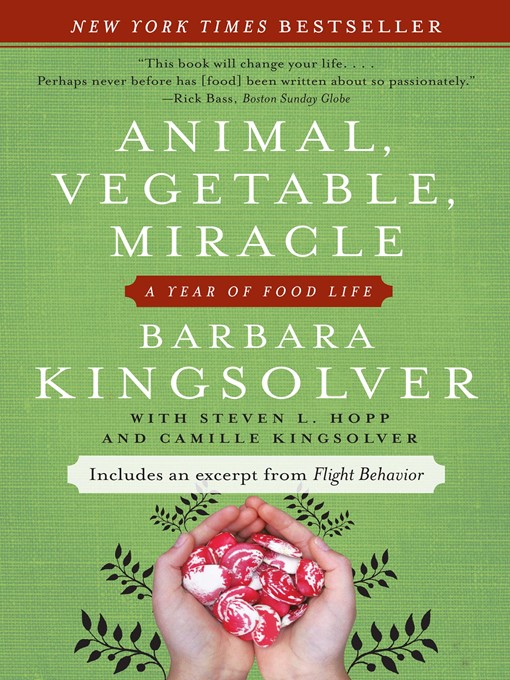
Barbara Kingsolver is, of course, a noted fiction writer (if you haven't read The Bean Trees, you should get that one too) but this book is non-fiction. It is the story of Barbara and her family and the year they spent living on a farm eating only local food. They grew much of their own.
Kingsolver's storytelling skills make this a pleasure to read as she chronicles the struggles of raising turkeys, attempting to plan a large birthday party without the convenience of store-bought food, and adventures in learning to make cheese.
Interspersed throughout the book are some of the family's favorite recipes, information about eating seasonally, and facts about the industrial agriculture.
But this book is not based on gory imagery or fear tactics. Instead, it is a beautiful book that not only makes you want to embrace the slow food philosophy in your own life, but makes you excited to do so.
It seems like a decent number of people have found the chocolate posts helpful and interesting, so that makes me happy. On facebook, Rose shared that the Kallari chocolate company is also a good one to support. She even knows some of the farmers, so you can't ask for a better recommendation than that.
In this post, I'd like to write about one of the books that was instrumental in changing the way that I think about food. And that book is Barbara Kingsolver's Animal, Vegetable, Miracle.
Just look at that beautiful cover. You want to read it already, don't you?
Barbara Kingsolver is, of course, a noted fiction writer (if you haven't read The Bean Trees, you should get that one too) but this book is non-fiction. It is the story of Barbara and her family and the year they spent living on a farm eating only local food. They grew much of their own.
Kingsolver's storytelling skills make this a pleasure to read as she chronicles the struggles of raising turkeys, attempting to plan a large birthday party without the convenience of store-bought food, and adventures in learning to make cheese.
Interspersed throughout the book are some of the family's favorite recipes, information about eating seasonally, and facts about the industrial agriculture.
But this book is not based on gory imagery or fear tactics. Instead, it is a beautiful book that not only makes you want to embrace the slow food philosophy in your own life, but makes you excited to do so.
Wednesday, December 5, 2012
I found out there's slavery in my chocolate and now my life is ruined. What do I do?
Alright, I'll tell you what I know. Welcome to
Victoria's Guide to Buying Chocolate NOT Produced with Child Slave Labor
First, you can buy organic chocolate. This is not a perfect guarantee, but organic chocolate most likley was not produced with slave labor, because there are no certified organic farms in Cote d'Ivorie, where most of the issues occur. The majority of organic cocoa farms are in South America where slavery has not been found to occur. (Source)

Humans in Provo: You can buy Organic Chocolate Chips at Smith's or in SLC at Whole Foods.
Brands of Organic Chocolate include Newman's Own Organics, Trader Joe's Brand chocolates, Green & Black, and Dagoba.
For baking, Whole Foods and Harmon's sell Organic cocoa powder.

Next, you can buy Fair Trade Certified chocolate, which means that fair labor practices have been verified by an independent third party group.

Other certifications include Rainforest Alliance certification and Fair for Life. All of these logos are ones you should look for!

There are lots of lists available of every company that is Fair Trade certified, but they're overwhelming and sometimes outdated. Rather than memorize a list of everyone you can buy from, just look at the packaging on the chocolate you're considering buying. Is it organic? Does it have any of the above fair trade labels? Is the country of origin listed?
I'll make a plug here for my personal favorite chocolate company, Theo, which recently came out with a Fair Trade bar from the Democratic Republic of Congo. Also, if you ever go to Seattle you can tour their chocolate factory, which is super fun.
In most stores in Provo, all of these kinds of chocolate will be displayed together in grocery stores. You can get Fair trade chocolate bars at Sprouts, Good Earth, Allen's, Whole Foods,Trader Joe's, Harmon's, and some Smith's stores in Salt Lake City.
Like most things involving international trade, Fair Trade is complicated and has its critics. Here is a great blog post that discusses some of the potential issues with Fair Trade, as well as providing lists of slavery-free chocolate and companies that are working towards eradicating slavery in their supply lines.
You can read about the specific requirements that different fair trade labels require by visiting the label's website. So if you want to buy something, but are unsure what the label means, just get on their website!

And finally, activism. Choosing to buy slavery-free chocolate is great, but it's also important to let companies know how you feel. Currently, one of the most successful campaigns is Raise the Bar, Hershey! Thanks to the efforts of this campaign, Hershey's Bliss Bars will be Rainforest Alliance Certified in 2013, and the company has agreed to certify all of its cocoa by 2020. However, there is still work to be done.
(It is worth noting that Dagoba, though Fair Trade, is owned by Hershey, and so the Raise the Bar, Hershey Campaign also boycotts that brand. But that's up to you).
My friend and I have a rule about our cocoa purchasing. Mostly, we buy organic and fair trade. But if we decide to buy something that isn't certified, then we have to write the company a letter expressing our concern. Letter writing is very important. Few people take the time to do it, and so when you send a company a letter (particularly a hand-written letter) they assume that you represent numerous concerned consumers.
Best of luck in your cocoa purchasing and activism journey! Hopefully this wasn't too overwhelming- I promise, it isn't hard to find ethically produced chocolate if you just start looking around. And if your local grocery store doesn't carry any fair trade or organic chocolate, tell them that you want it! The wonderful thing about being a consumer is that you get to create demand.
Wednesday, November 28, 2012
Is There Slavery in Your Chocolate?
Most likely.

Sorry to be the bearer of bad news.
I was already vaguely aware that slavery was used in the production of chocolate, but recently I wrote a paper on the topic and I now feel much more qualified to speak on the subject. Here is my research paper, Reader's Digest version:
Most cocoa used in the largest chocolate brands comes from Africa, particularly Cote d'Ivorie. Investigations have revealed that the cocoa industry in the following countries uses child labor or forced labor:
Cameroon
Cote d'Ivorie
Ghana
Guinea
Nigeria
Sierra Leone
Sierra Leone
Want proof? Good for you, here are some links:

Now, are you skeptical that "child labor" is inherently a bad thing? Are we perhaps wrongly projecting my western view of children and work onto other cultures?
Maybe. But the kinds of child labor we're talking about eliminating are known as the "Worst Forms of Child Labor"as defined by the International Labor Organization, a department of the U.N. Here is what is considered Worst Forms of Child Labor:
(a) all forms of slavery or practices similar to slavery, such as the sale and trafficking of children, debt bondage and serfdom and forced or compulsory labour, including forced or compulsory recruitment of children for use in armed conflict;
(b) the use, procuring or offering of a child for prostitution, for the production of pornography or for pornographic performances;
(c) the use, procuring or offering of a child for illicit activities, in particular for the production and trafficking of drugs as defined in the relevant international treaties;
(d) work which, by its nature or the circumstances in which it is carried out, is likely to harm the health, safety or morals of children.
I mean, that's pretty bad. It is also the type of thing that the chocolate industry has been promising to do its part to eradicate for the past 10 years.
The Chocolate Manufacturers Association, which represents some of the top companies in the industry (Hershey, M&M Mars, Nestle, See's, etc etc etc) stepped in in 2001 when the United States congress was about to pass a bill requiring them to label chocolate "Slave Free" if it used no child labor. They came up with a compromise, known as the Harkin-Engel Protocol, in which the industry promised to work to end child slavery in their supply line.

Want to see the CEO's signatures on this promise? They're right here.
The companies who signed this protocol have repeatedly missed the deadlines to fulfill their promises. The Payson Center, which oversees compliance with the agreement, said in 2011 that the chocolate industry had not completely fulfilled any of the the promises made.
Perhaps the companies can't regulate their suppliers. Maybe we're making the wrong people responsible for the problem. That could be true. Global trade is certainly not simple.
But then again, plenty of other companies have managed to keep slavery out of their chocolate, largely by using Fair Trade certified chocolate, which has certain standards that producers must meet. Whether or not Fair Trade certified is the way to go is open for debate- but it is one way of ensuring that a suppliers are not committing labor abuses.
And Chocolate companies do not have to use the Fair Trade system. One of the agreements of the Protocol was that the industry could come up with it's own third-party verified labeling system. Maybe something like this:

That's going to be all for Part one of this. Next week, or sometime soon when I feel like it, I'll talk about current consumer campaigns and companies committed to fair trade chocolate, and how to buy slavery free chocolate.
Monday, November 19, 2012
Freeganism

Look at all of that delicious food. All those bright colorful vegetables...all those bell peppers that cost a dollar or more in the grocery store. We got them for free. From a dumpster.
Ah yes, Freeganism, perhaps the most controversial of all the alternative food lifestyles. I'll tell you about my experience with it, and you can judge it as you like.
For about 2 months, I was a part of a regular dumpster diving group. There were about 10 of us, and we went every Thursday night at midnight. We quickly learned which stores to go to (some have indoor dumpsters, trash compactors, or locked dumpsters, so they're no good), and what our local laws about dumpster diving were. We developed regular routes, split into two groups, and returned at about 2:00am to divide up our spoils (get it?!).
I usually wore crappy clothes and dishwasher gloves and we brought headlamps. One or two people would climb into the actual dumpster and hand things out to the others to examine and pack into the car.
Dumpsters are not as gross as you would think they are. Don't get me wrong- some were horrible. But mostly, the trash is contained in separate bags, so the dumpster itself is clean. Produce is usually in a bag with other produce, not other kinds of trash, so it's pretty clean.
There were often gallons and half gallons of milk that weren't even expired, still cold from the store coolers. They would have dents in the handles or cartons. There were bell peppers that were oddly shaped or colored, but otherwise fine. We'd take cartons of berries and pick out the moldy ones, cut bruises out of apples, soft spots out of cucumbers. We washed everything in vinegar and hot water before we ate it. No one in the group ever got sick.
Basically, that's how dumpster diving is. It can be messy, it requires some work, but as long as you use your judgement, it's a pretty good way to cut down your grocery bill.
Monday, November 12, 2012
Food Waste
I'm tired of writing about GMO's. Although, if you're interested, California did not vote to label them.
Let's turn to what is possibly the most infuriating topic in the whole world: Food Waste.
Our source today is a TED talk:
Tristram Stuart: The global food waste scandal
This is a video well-worth watching yourself, but I'll just give you the basics.In America, we throw away a tremendous amount of food. And not just rotten food, no, most of the food we throw away is fit for consumption. We throw away food because it is too small for supermarket regulation, or because of "cosmetic blemishes." All told, there is twice as much food in our grocery stores as is necessary to feed our population. Though some food waste is inevitable, the amount we throw away is staggering, particularly in a world where millions are starving.
Perhaps next time I'll discuss my own adventures in "Freeganism."
Tuesday, November 6, 2012
And while we're on the subject of GMO's...
I really appreciated this article from NPR which debunks commonly held beliefs about GMOs. There were a few things that I discovered that I had wrong. For people who are in my Food class, this will be helpful to read as we watch Food, Inc this week. It is always important to make sure you have your facts straight whenever you are taking a side on any issue.
Five Myths about GMOs debunked
Five Myths about GMOs debunked
Friday, October 26, 2012
Vote Now: GMO Food
Though little discussed by the presidential candidates, Genetically Modified Organisms are a hot topic this election year. Twenty-one states have a ballot measure relaying to the labeling of GMO food.
The arguments go like this:
Those in favor of GMO labeling feel that consumers have a right to know what kind of ingredients their food is made out of. Some believe that GMO's are dangerous, or that buying GMO supports companies such as Monsanto.
Those opposed say that labeling GMO's creates unnecessary fear in consumers; GMO food are no more dangerous than any other type of food.
Personally, I am always in favor of understanding where your food comes from and what it is. Even if the food is the nutritionally the same, if consumers want to know what they're buying, then they should be allowed to know. To me, it is more deceptive to keep people in the dark.
The arguments go like this:
Those in favor of GMO labeling feel that consumers have a right to know what kind of ingredients their food is made out of. Some believe that GMO's are dangerous, or that buying GMO supports companies such as Monsanto.
Those opposed say that labeling GMO's creates unnecessary fear in consumers; GMO food are no more dangerous than any other type of food.
Personally, I am always in favor of understanding where your food comes from and what it is. Even if the food is the nutritionally the same, if consumers want to know what they're buying, then they should be allowed to know. To me, it is more deceptive to keep people in the dark.
Tuesday, October 16, 2012
Monsanto vs. Farmers
Monsanto and its food patents may be the most important issue at the center of the new food movement. The powerful company has singlehandedly transformed farming into what it is today. For those who do not know, here is the basic situation is this: Monsanto produces genetically modified seeds, notably Round-Up Ready Soybeans, which are bred to be resistant to pests and disease. Because they are genetically modified Monsanto claims the seeds as intellectual property meaning that farmers cannot save seeds from year to year, but must buy new seeds every season. Further problems arise when genes from Monsanto plants drift into non-Monsanto crops, in which case Monsanto claims them as intellectual property.
A number of court cases have brought up against Monsanto, however, its tactics have always been upheld as legal. However, for the first time the Supreme Court will look at a case of an Indiana Farmer vs. Monsanto. Many claim that Monsanto constitutes a monopoly of the seed market, and it is possible that the Supreme Court ruling will result in significant policy change.

http://www.npr.org/blogs/thesalt/2012/10/16/162949288/farmer-tackling-monsantos-seed-policy-gets-a-day-in-supreme-court
A number of court cases have brought up against Monsanto, however, its tactics have always been upheld as legal. However, for the first time the Supreme Court will look at a case of an Indiana Farmer vs. Monsanto. Many claim that Monsanto constitutes a monopoly of the seed market, and it is possible that the Supreme Court ruling will result in significant policy change.
http://www.npr.org/blogs/thesalt/2012/10/16/162949288/farmer-tackling-monsantos-seed-policy-gets-a-day-in-supreme-court
Sunday, September 30, 2012
Eating Animals

This week, I read the book Eating Animals by Jonathan Safran Foer, the author of the non-fiction novels Extremely Loud and Incredibly Close (which I highly recommend) and Everything is Illuminated. I have been a vegetarian for about two and a half years now, converted by Barbara Kingsolver's Animal, Vegetable, Miracle (another fiction writer's venture into non-fiction food writing), the documentary Food,Inc., and Michael's Pollan's The Omnivore's Dilemma. I have actually consciously avoided reading futher vegetarian/animal rights/factory farming books, because I'd rather learn new things than just read for confirmation bias. However, a friend recommended this one, so I gave it a go.
First of all, Jonathan Safran Foer is a fabulous writer. He begins this book with the story of his grandmother, who spent many years of her life starving and was therefore obsessively concerned with the nutrition of her family. Far from being simply an exercise in feeling morally superior, this book provided me with lots of new information and things to think about (notably, Natalie Portman credits this book with turning her from a 20-year vegetarian to a vegan activist). In The Omnivore's Dilemma, Michael Pollan does a great job investigating sources of food, and in documenting problems in the cattle industry; however, the cattle industry is just the tip of the iceberg. Foer discusses commercial fishing, and the industry standard practices for the raising and slaughter of chicken, turkey, and pigs. Interestingly he challenged Pollan on some points- perhaps most notably when an heirloom turkey farmer declares his distaste for Joel Salatin's chicken farm, upheld as an ideal of farming in both The Omnivore's Dilemma and Food, Inc.
There is so much material worth discussing in this book, perhaps I will dedicate later blog posts to it. However, to keep this post reasonable, I will just end by recommending that everyone read this book. No, it is not always pleasant- parts of it felt like a modern-day version of The Jungle. Many people are reticent to learn more about the meat industry, because everyone knows that what they find will be ugly and then they'll feel compelled to change their behavior.
But why don't we want to know what we're buying? We spend our money on it, we use it as a source of energy, by eating it we allow it to become a part of ourselves. So why wouldn't we want to know what we're allowing to be such a big part of our lives? Consumers have the most power to change the meat industry in America. Laws can be made, and loopholes will be found. But if people refuse to buy a product that does not meet their standard for humaneness, or environmental protection, companies have no choice but to change their practices.
 |
| See an Index of Information on Poultry from Eating Animals here |
Sunday, September 23, 2012
Imagining Food
It follows that food, being a huge part of everyday life, also has a significant presence in literature. This week, NPR's Picture Show posted an article about Dinah Fried's series of photographs, in which the artist photographs meals created based on the literary descriptions in classic literature.

Like this representation of the Mad Hatter's Tea Party from Alice in Wonderland...

Or this envisioning of a meal from To Kill a Mockingbird.
I like these photographs because they offer a new way to put yourself into the shoes of the character. They are photographed about as they would look if you were the one sitting at the table, prepared to eat the meal. They give you a tangible image of the setting in which you find yourself, and one can imagine looking up and around seeing the rest of the scene laid before your eyes in vivid detail.
This series also made me reflect on the role that food plays in literature. Sensory details play an important role in the description of any setting, however taste is not always applicable. Though sight, sound, smell, and touch are always applicable, taste is not. In spite of this, the description of meals adds greatly to the reader's understanding of the character of a place. For example, in the Harry Potter series, Harry eats stale bread, cheese, and soup, and is always hungry. Part of what creates your understanding of Hogwarts as Harry's true home, and infinitely better place, is that there are tables laden with good food every day, frequent feasts, and a variety of delicious, magical things to try. Appropriate use of food culture can bring the reader into the story just as much as dialect can.
So, cheesy Participation Question of the Day- if you were going to photograph a food scene from a book, which one would it be?
Like this representation of the Mad Hatter's Tea Party from Alice in Wonderland...
Or this envisioning of a meal from To Kill a Mockingbird.
I like these photographs because they offer a new way to put yourself into the shoes of the character. They are photographed about as they would look if you were the one sitting at the table, prepared to eat the meal. They give you a tangible image of the setting in which you find yourself, and one can imagine looking up and around seeing the rest of the scene laid before your eyes in vivid detail.
This series also made me reflect on the role that food plays in literature. Sensory details play an important role in the description of any setting, however taste is not always applicable. Though sight, sound, smell, and touch are always applicable, taste is not. In spite of this, the description of meals adds greatly to the reader's understanding of the character of a place. For example, in the Harry Potter series, Harry eats stale bread, cheese, and soup, and is always hungry. Part of what creates your understanding of Hogwarts as Harry's true home, and infinitely better place, is that there are tables laden with good food every day, frequent feasts, and a variety of delicious, magical things to try. Appropriate use of food culture can bring the reader into the story just as much as dialect can.
So, cheesy Participation Question of the Day- if you were going to photograph a food scene from a book, which one would it be?
Sunday, September 16, 2012
Of Soda Bans and McDonald's Calories
McDonald's has announced that starting this week, it will voluntarily begin posting the calorie content of its food on the menu for all customers to see. Under the health care reform bill, all restaurant chains with more than 20 locations will be required to post their calorie information, so McDonald's seems to be putting the requirement into place early. The theory behind posting calorie information is that consumers will make better decisions and companies will have incentive to produce healthier products, thereby reducing societal health problems related to obesity and diabetes. This makes perfect sense to me- in New York City, where local law requires the posting of calorie information, seeing the calorie counts had a big impact on my food purchases. But some studies have shown no difference in food purchases when laws like this are implemented. Why is that? Are consumers already aware of and indifferent to the high caloric content of their food? And what does McDonald's hope to gain by posting this information?
The other big food-related story this week was that New York City has added yet another controversial law to its books. The city has already banned trans-fats and requires calorie listings, but this week it banned sodas over 16 oz from being sold by restaurants, cafeterias, and concession stands. Supporters call it an important step in the war against obesity, but many people feel the law is too strict, and infringes on their rights as consumers. On the one hand, there is really no good reason to drink soda, and it is a major source of sugar with no nutritional benefits. Generally, I tend to support New York's tough food laws- the government, after all, has a vested interest in a healthy population. And it isn't as though people are being banned from drinking soda all together, or can't get more than 16oz of it if they feel so compelled. It has simply been made more inconvenient to do so. On the other hand, I can see why people get nervous about the government making a law which effects their personal, day-to-day decisions.
The other big food-related story this week was that New York City has added yet another controversial law to its books. The city has already banned trans-fats and requires calorie listings, but this week it banned sodas over 16 oz from being sold by restaurants, cafeterias, and concession stands. Supporters call it an important step in the war against obesity, but many people feel the law is too strict, and infringes on their rights as consumers. On the one hand, there is really no good reason to drink soda, and it is a major source of sugar with no nutritional benefits. Generally, I tend to support New York's tough food laws- the government, after all, has a vested interest in a healthy population. And it isn't as though people are being banned from drinking soda all together, or can't get more than 16oz of it if they feel so compelled. It has simply been made more inconvenient to do so. On the other hand, I can see why people get nervous about the government making a law which effects their personal, day-to-day decisions.
Tuesday, September 11, 2012
What to do with September 11th?
So, this blog is supposed to be about food now. But it’s
September 11th, and I have to do something about September 11th.
Every year, I find myself wondering about this, and I don’t
know. What am I supposed to do with
September 11th?

I don’t have any special 9/11 story. No relatives or friends
in the towers, no military parents, no very personal connection to any of it,
really. But I remember where I was, just like everyone else does. I was at
Orchard Park Elementary School, standing in line with the rest of my class
after our Spanish hour, waiting for our teacher to come get us. And waiting and
waiting and waiting. And when she did come, she came walking quickly, and with
a strange look on her face, and another teacher with her. They spoke in a
whispering huddle with the Spanish teacher for a long time. And then she took
us back to our normal classroom, and she sat us all down, and she told us what
happened.
But it didn’t mean anything right then. I didn’t know what
the World Trade Center was; I didn’t know what the Pentagon was; I didn’t know
what it looked like when a plane smashed into a building. She told us that we
didn’t need to be afraid, but I didn’t even know I had anything to be afraid
of. I was eleven and in the fifth grade, and I didn’t know much of anything about
anything. People just a few years younger than me probably don’t remember much
about that day at all. As the years go on and on and we all grow old, my peers
and I will eventually be among the last few who do remember.
But I don’t think that any of us know what to do with September
11th now. The memorials get smaller and for the most part we go about
our business. People don’t seem to think about it, they don’t mention it during the day, and you’re allowed to schedule normal events on it now. And I know that as the years go on, that will probably become more and more true. Maybe it’s better that way.
Maybe we need to just go on about our business. Maybe if we’re too sad, the
terrorists win. Maybe.
I certainly don’t blame anyone for not wanting to think about it. I
hate that it’s called Patriot’s Day- the word “Patriot” just brings back memories
of freedom fries, and bitter elections, and wars founded on lies. Plus, there
isn’t much about September 11th that makes me feel particularly
patriotic. All those people in the towers and the Pentagon didn’t go to work
that day with any idea of being martyrs for the cause of freedom. It was a mass
murder and that doesn’t make me feel especially devoted to my country; it just
makes me feel sad. So I don't feel like I can commemorate 9/11 by celebrating America, although maybe that would be the most positive way to do it- to focus on our identity as a unified nation, one that has recovered and held it together. But that doesn't seem right either. This doesn't feel like a unified nation to me, and it doesn't feel like we've recovered either. I don't think you ever really recover from something like September 11th, you just make a new normal. And that's where we live now.
But still, I want to keep mourning the kind of hate that causes
this kind of thing to happen, because it will never stop being a tragedy. I
don’t want to pretend that September 11th happened and is all over,
when the repercussions are still reverberating all over the world. I don’t want
to forget that the 3,000 people who died that day were just the beginning the
thousands that would die in the ensuing “War on Terror.” I want to commemorate
the day that everything changed. I want to pray for peace. I want to think and talk about what kind of
world I live in, and why. Especially for me, and the people my age, even if we
were young and we didn’t really understand, we were raised in the aftermath of
September 11th. We, of all people, the group that will be the last
ones to remember, should stop and reflect on the events that turned our world
into the one it is now.
And this year, I guess that’s what I’ll do about September
11th.

Sunday, June 10, 2012
When words aren't enough
I've never been one to be super in to instrumental music, but lately I'm finding it a much better expression of my feelings than any of my music with lyrics has been.
I've gotten very into Phillip Glass and Yann Tiersen. If finals are getting you down, make a Pandora station with those two.
And check out this awesome video.
http://www.youtube.com/watch?v=KvZix38meQs&feature=related
Who knew the Robot could be so beautiful?
I've gotten very into Phillip Glass and Yann Tiersen. If finals are getting you down, make a Pandora station with those two.
And check out this awesome video.
http://www.youtube.com/watch?v=KvZix38meQs&feature=related
Who knew the Robot could be so beautiful?
Sunday, June 3, 2012
Marching in Pride Parades: A sabbath activity


My CNN ireport is here.
Sunday, May 27, 2012
First Listen: Edward Sharpe and the Magnetic Zeros
Edward Sharpe and the Magnetic Zeros (famous for this song) have a new album coming out on Tuesday. I like this band, but mostly because they always seem to be having the most fun possible and I wish I was in on it. But, I have listened to...most....of their upcoming album, and overall I think I like it more than their first one. I am particularly enchanted by the song "I Don't Want to Pray," the lyrics to which I find somewhat fascinating. "That's What's Up" is also really cute and fun. Anyway, if you're looking for some gospel revival-esque type fun by a band you'd love to party with, I'd check out "Here" here. ;-)
Saturday, May 26, 2012
This is NPR
With the world full of sensationalist news corporations, with their gory details, 24 hour cycles, and endless bickering, it's nice to know that we still have NPR. I know that it's bad to be have a single source of news, but mine is NPR and I couldn't be happier about it. I wake up almost every morning to their fabulous radio voices calming reporting the news of the world. At work, I listen to Radio West or This American Life and hear the most fascinating stories and ideas. During the day, I often scroll through their website, catching first listens of Regina Spektor, Sigur Ros, or Edward Sharpe and the Magnetic Zeros, or book reviews. No stressful scroll bar touting the days disasters there, no long lists of disastrous news. Just good, high quality journalism that informs and educates.
Sunday, May 20, 2012
Storytelling
Storytelling is a wonderful, wonderful art form. Storytelling is at the heart of most of our media...TV shows, movies, music, blogs, etc. The most interesting unique feature of human beings is our need to self-express and get outside of ourselves. Our earliest ancestors made cave paintings. We do not know what story they were trying to tell, but for whatever reason they felt compelled to create something.
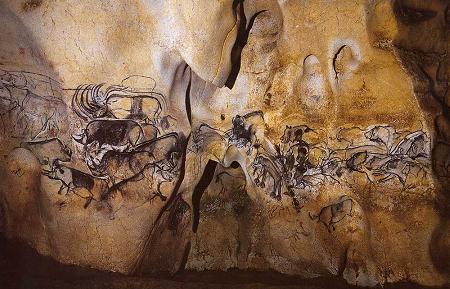
I try to think of what the reason could be for this need. Lately, I have been writing obsessively in my journal. Who am I writing to? Why am I writing? I don't especially want anyone to read it. But it seems important to me to get things down, to make them tangible somewhere.
Almost every month, I go to Provo's live storytelling show The Porch (Come! It's so great!), to hear my fellow community members tell stories. The purpose of the porch is for us to realize the different types of stories that can be found in our community. And I love it, and it's fascinating. But why? Why am I interested in other people's experiences?
Maybe it's because all of us only have one life, and though we will all experience many things, there are invariably some things we will miss out on. Furthermore, we can only understand our own lives, so hearing about the lives of others increases our understanding of the world that we live in. I wish I had better answers. I'll keep thinking about it.
I try to think of what the reason could be for this need. Lately, I have been writing obsessively in my journal. Who am I writing to? Why am I writing? I don't especially want anyone to read it. But it seems important to me to get things down, to make them tangible somewhere.
Almost every month, I go to Provo's live storytelling show The Porch (Come! It's so great!), to hear my fellow community members tell stories. The purpose of the porch is for us to realize the different types of stories that can be found in our community. And I love it, and it's fascinating. But why? Why am I interested in other people's experiences?
Maybe it's because all of us only have one life, and though we will all experience many things, there are invariably some things we will miss out on. Furthermore, we can only understand our own lives, so hearing about the lives of others increases our understanding of the world that we live in. I wish I had better answers. I'll keep thinking about it.
Wednesday, May 16, 2012
What are we letting into our homes?

In the It Gets Better at BYU video, some LGBT students voiced their conviction that their fellow students are not hateful. One mentions that when he comes out to people, those people often become their strongest advocates. I've heard this said over and over, it seems to be a well-documented truth that once someone knows a gay person, their views change dramatically.
So, I found this article (NPR: How television brought gay people into our homes) really interesting, as it relates to the fact that Americans have grown increasingly accepting of the idea of same-sex marriage. In 1996, only 27% were in support, while current polls show the approval rate at around or slightly above 50%. I certainly don't think that TV is responsible alone for this, but it's interesting to examine this idea.

Cultivation theory says that TV has a long term cumulative effect on attitudes, so if acceptance of homosexuality or support for same-sex marriage is depicted more on TV, there could be some effect on the attitudes of viewers. There is also the personal relationships theory, which says that people often watch certain TV shows because they relate to the characters, and feel that they have a relationship with them. So, could it be that when one watches a show and finds themselves relating to a gay character, their feelings towards real gay people change? Could a loveable gay television character have something of a similar effect on someone's views as making a gay friend?
Now, please don't misunderstand- I am not at all saying that liking a gay TV character is the same as knowing a gay person, or that someone could understand all gay people through a TV show. You can't. Media characters will never be a 3-dimensional as a real person. But I am saying that TV characters have the potential to challenge preconceived notions of what gay people are like by showing alternatives to one's mental schema.
Friday, May 4, 2012
The Iron Lady

The film is very beautiful, and was rightfully also awarded an Oscar for best makeup, as Meryl Streep plays Margaret from middle to old age.

It's an interesting exploration of the life of a female leader. Margaret makes her way up by refusing to compromise, which is both her strength and her weakness. At times, her political ambitions cause discord within her family. But right or wrong, Margaret is an admirable and inspiring woman. I loved the exploration of gender roles. Did Margaret truly neglect her family, or did her family resent her circumvention of traditional gender roles? Is the fact that she was a woman in a man's world force her to be uncompromising in order to survive? Also, why has Britain had a female prime minister, but America has had no female president?

Wednesday, May 2, 2012
The play that all of happy valley should see
Robbie Pierce's play, Wings of Wax, has been performed approximately 5 times. I feel very lucky to be one of the few people who has had the opportunity to see it because I want everyone to see this play.
It is based on the Greek myth of Icarus, who flies too close to the sun on wings of wax, which melt and send him plunging into the sea to drown. It centers on the life of October "Toby" Glantz, a young man who finds himself both Mormon and gay. The play follows him as he tries to exist while these two opposing identities pull him in different directions.
"I’m being stretched. Being pulled to somewhere beautiful, and at the same time stuck right where I am. Bound. The word “bound.” Do you ever think about it? It’s an antagonym. An auto-antonym, or a Janus word, after the two-faced Roman God. It’s a word that’s the opposite of itself. Just like me, which I suppose is the appeal. I collect this sort of word. You can be bound for something, which means you’re headed there, fast. Or you can be bound to something, which means that you’re stuck. Fast. And somehow I’m both. We’re all both. A self-contradiction of who we are and who we would be."
I really can't say enough about this play- if I say everything that I think about it, I will just be gushing, which would be obnoxious. I will suffice to say that the actors do an incredibly good job, and that the emotional intensity is at times incredibly high, but never overwrought.
The desire of this play is not to be directly activist or political; it simply tells a very honest, personal story. Every character is sincerely well-intentioned, but those intentions translate into very different actions. Depending on who you are, you will interpret those actions and characters in different ways. But no matter what, you will feel something. And if you refuse to think about what you feel, you will hate this play.
Hopefully, this play will be picked up and performed in Provo this summer. If it is, you can rest assured that I will let you know.
It is based on the Greek myth of Icarus, who flies too close to the sun on wings of wax, which melt and send him plunging into the sea to drown. It centers on the life of October "Toby" Glantz, a young man who finds himself both Mormon and gay. The play follows him as he tries to exist while these two opposing identities pull him in different directions.
"I’m being stretched. Being pulled to somewhere beautiful, and at the same time stuck right where I am. Bound. The word “bound.” Do you ever think about it? It’s an antagonym. An auto-antonym, or a Janus word, after the two-faced Roman God. It’s a word that’s the opposite of itself. Just like me, which I suppose is the appeal. I collect this sort of word. You can be bound for something, which means you’re headed there, fast. Or you can be bound to something, which means that you’re stuck. Fast. And somehow I’m both. We’re all both. A self-contradiction of who we are and who we would be."
I really can't say enough about this play- if I say everything that I think about it, I will just be gushing, which would be obnoxious. I will suffice to say that the actors do an incredibly good job, and that the emotional intensity is at times incredibly high, but never overwrought.
The desire of this play is not to be directly activist or political; it simply tells a very honest, personal story. Every character is sincerely well-intentioned, but those intentions translate into very different actions. Depending on who you are, you will interpret those actions and characters in different ways. But no matter what, you will feel something. And if you refuse to think about what you feel, you will hate this play.
Hopefully, this play will be picked up and performed in Provo this summer. If it is, you can rest assured that I will let you know.
Subscribe to:
Posts (Atom)