Last post, probably for a while. I want to finish up by talking about one of the questions I have to ask myself every now and again: Does any of it matter?
After I became a vegetarian, I told one of my good friends about why I had decided to do it. And she said, "Well, I'm glad you think that does something."
She has a point, right? I think this is what stops many of my ethically minded friends from making radical life changes for idealistic moral reasons. Does it really make any difference for one person to stop buying meat? Can our refusal to eat most chocolate really end slavery in another country?
To be honest, I don't know. The machine, so to speak, is overwhelmingly large.
But what I do know is that it definitely doesn't help anything for you to do nothing. I feel that being a vegetarian has allowed me to introduce lots of people to issues within the food industry, or the concept of animal rights. I don't know that I've ever changed anyone's mind. But I think I have gotten some people to broaden their thinking. And, in my opinion, when lots of people start broadening their minds, that is when real change can happen.
Thursday, December 6, 2012

Food, Inc.
Oh hello. I didn't see you there. Have you missed me for the 30 seconds between these posts?
While I finish up my blog, I'd like to talk about some other major influences on my food philosophy.

By now, you've probably seen it. It's free on Netflix, it's one of the most successful current food documentaries. If you haven't, go watch it. I first saw it over Christmas Break 2009. After watching it, it just seemed incredibly clear to me that I needed to be a vegetarian. I had already known this, really, after reading Animal, Vegetable, Miracle a few months earlier. But watching Food, Inc., I just felt that I had no excuse. I knew the facts, I knew where my food was coming from, and morally it didn't seem to make any sense to me to continue buying a product when I knew I did not like the way it was being produced. So I quit. And it's been great, I absolutely love being a vegetarian.
Animal, Vegetable, Miracle
Well, it's the last day of the semester, and time for me to squish in some last minute posts for grade purposes. That's lame, but at least I'm being up front about it.
It seems like a decent number of people have found the chocolate posts helpful and interesting, so that makes me happy. On facebook, Rose shared that the Kallari chocolate company is also a good one to support. She even knows some of the farmers, so you can't ask for a better recommendation than that.
In this post, I'd like to write about one of the books that was instrumental in changing the way that I think about food. And that book is Barbara Kingsolver's Animal, Vegetable, Miracle.
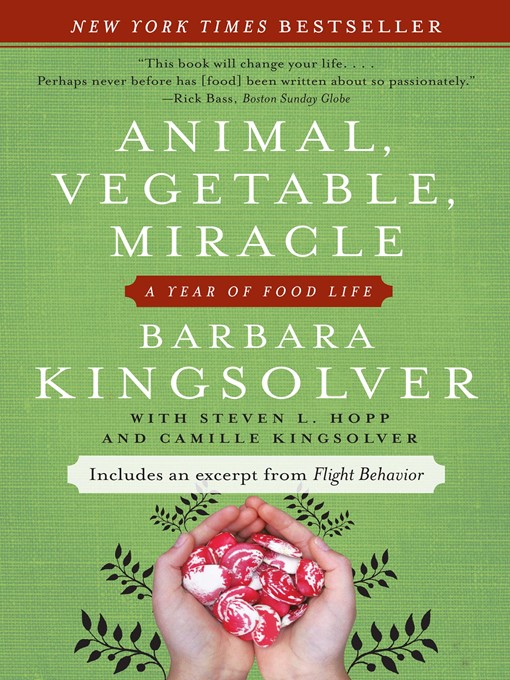
Barbara Kingsolver is, of course, a noted fiction writer (if you haven't read The Bean Trees, you should get that one too) but this book is non-fiction. It is the story of Barbara and her family and the year they spent living on a farm eating only local food. They grew much of their own.
Kingsolver's storytelling skills make this a pleasure to read as she chronicles the struggles of raising turkeys, attempting to plan a large birthday party without the convenience of store-bought food, and adventures in learning to make cheese.
Interspersed throughout the book are some of the family's favorite recipes, information about eating seasonally, and facts about the industrial agriculture.
But this book is not based on gory imagery or fear tactics. Instead, it is a beautiful book that not only makes you want to embrace the slow food philosophy in your own life, but makes you excited to do so.
It seems like a decent number of people have found the chocolate posts helpful and interesting, so that makes me happy. On facebook, Rose shared that the Kallari chocolate company is also a good one to support. She even knows some of the farmers, so you can't ask for a better recommendation than that.
In this post, I'd like to write about one of the books that was instrumental in changing the way that I think about food. And that book is Barbara Kingsolver's Animal, Vegetable, Miracle.
Just look at that beautiful cover. You want to read it already, don't you?
Barbara Kingsolver is, of course, a noted fiction writer (if you haven't read The Bean Trees, you should get that one too) but this book is non-fiction. It is the story of Barbara and her family and the year they spent living on a farm eating only local food. They grew much of their own.
Kingsolver's storytelling skills make this a pleasure to read as she chronicles the struggles of raising turkeys, attempting to plan a large birthday party without the convenience of store-bought food, and adventures in learning to make cheese.
Interspersed throughout the book are some of the family's favorite recipes, information about eating seasonally, and facts about the industrial agriculture.
But this book is not based on gory imagery or fear tactics. Instead, it is a beautiful book that not only makes you want to embrace the slow food philosophy in your own life, but makes you excited to do so.
Wednesday, December 5, 2012
I found out there's slavery in my chocolate and now my life is ruined. What do I do?
Alright, I'll tell you what I know. Welcome to
Victoria's Guide to Buying Chocolate NOT Produced with Child Slave Labor
First, you can buy organic chocolate. This is not a perfect guarantee, but organic chocolate most likley was not produced with slave labor, because there are no certified organic farms in Cote d'Ivorie, where most of the issues occur. The majority of organic cocoa farms are in South America where slavery has not been found to occur. (Source)

Humans in Provo: You can buy Organic Chocolate Chips at Smith's or in SLC at Whole Foods.
Brands of Organic Chocolate include Newman's Own Organics, Trader Joe's Brand chocolates, Green & Black, and Dagoba.
For baking, Whole Foods and Harmon's sell Organic cocoa powder.

Next, you can buy Fair Trade Certified chocolate, which means that fair labor practices have been verified by an independent third party group.

Other certifications include Rainforest Alliance certification and Fair for Life. All of these logos are ones you should look for!

There are lots of lists available of every company that is Fair Trade certified, but they're overwhelming and sometimes outdated. Rather than memorize a list of everyone you can buy from, just look at the packaging on the chocolate you're considering buying. Is it organic? Does it have any of the above fair trade labels? Is the country of origin listed?
I'll make a plug here for my personal favorite chocolate company, Theo, which recently came out with a Fair Trade bar from the Democratic Republic of Congo. Also, if you ever go to Seattle you can tour their chocolate factory, which is super fun.
In most stores in Provo, all of these kinds of chocolate will be displayed together in grocery stores. You can get Fair trade chocolate bars at Sprouts, Good Earth, Allen's, Whole Foods,Trader Joe's, Harmon's, and some Smith's stores in Salt Lake City.
Like most things involving international trade, Fair Trade is complicated and has its critics. Here is a great blog post that discusses some of the potential issues with Fair Trade, as well as providing lists of slavery-free chocolate and companies that are working towards eradicating slavery in their supply lines.
You can read about the specific requirements that different fair trade labels require by visiting the label's website. So if you want to buy something, but are unsure what the label means, just get on their website!

And finally, activism. Choosing to buy slavery-free chocolate is great, but it's also important to let companies know how you feel. Currently, one of the most successful campaigns is Raise the Bar, Hershey! Thanks to the efforts of this campaign, Hershey's Bliss Bars will be Rainforest Alliance Certified in 2013, and the company has agreed to certify all of its cocoa by 2020. However, there is still work to be done.
(It is worth noting that Dagoba, though Fair Trade, is owned by Hershey, and so the Raise the Bar, Hershey Campaign also boycotts that brand. But that's up to you).
My friend and I have a rule about our cocoa purchasing. Mostly, we buy organic and fair trade. But if we decide to buy something that isn't certified, then we have to write the company a letter expressing our concern. Letter writing is very important. Few people take the time to do it, and so when you send a company a letter (particularly a hand-written letter) they assume that you represent numerous concerned consumers.
Best of luck in your cocoa purchasing and activism journey! Hopefully this wasn't too overwhelming- I promise, it isn't hard to find ethically produced chocolate if you just start looking around. And if your local grocery store doesn't carry any fair trade or organic chocolate, tell them that you want it! The wonderful thing about being a consumer is that you get to create demand.
Subscribe to:
Posts (Atom)